

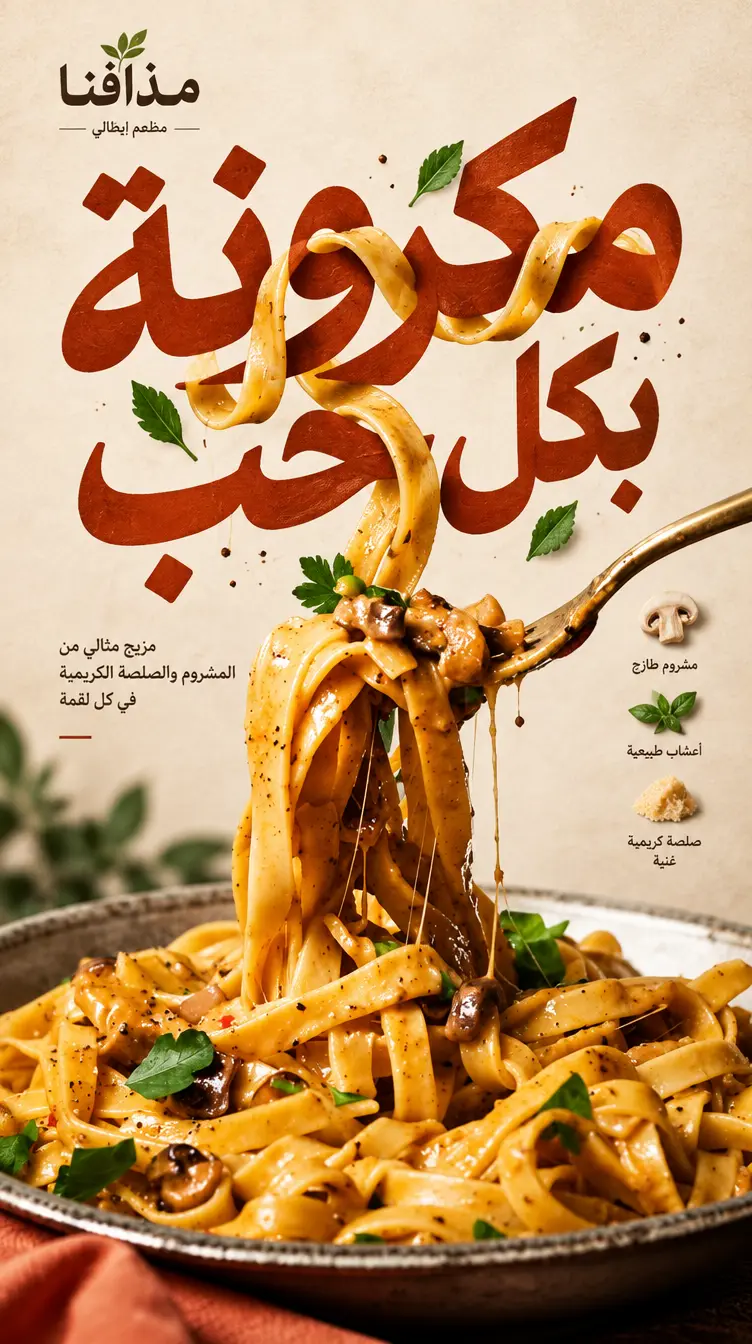
[BRAND]: [اسم البراند] [FOOD / DRINK]: [المنتج الرئيسي] [HEADLINE]: [الكلمة أو العنوان الرئيسي بالعربية] [INTERACTION]: [طريقة تفاعل الطعام مع الكتابة] [ACCENT COLOR]: [اللون الأساسي] [DETAILS]: [التفاصيل] Create a 9:16 vertical food editorial poster combining highly realistic food photography with bold, expressive Arabic typography. **LANGUAGE & TYPOGRAPHY — CRITICAL:** All visible written content in the design must be in **Arabic only**, unless a specific brand name is officially written in Latin characters. Write **[HEADLINE] exactly as provided in Arabic**. Preserve the exact Arabic spelling, letter order, connected letterforms, dots, diacritics if provided, and word structure. Use **correct right-to-left Arabic typography** with naturally connected Arabic letterforms. The Arabic headline must be fully readable, correctly spelled, and visually coherent. Do NOT translate the Arabic headline into English. Do NOT transliterate Arabic into Latin characters. Do NOT generate fake Arabic-looking symbols or pseudo-Arabic text. Do NOT reverse, mirror, disconnect, scramble, replace or randomly reshape Arabic letters. The typography should feel like **professional Arabic editorial art direction** — bold, contemporary, expressive and intentionally composed. Arabic type can be inspired by modern Arabic display typography, geometric Arabic lettering, expressive Arabic poster design or refined contemporary Arabic calligraphy, while remaining highly legible. Use the Arabic headline as one of the strongest visual elements of the composition. --- ### VISUAL DIRECTION Use a warm cream or ivory paper background with subtle natural paper texture. Keep the [FOOD / DRINK] highly realistic, appetizing and materially believable, with natural highlights, shadows, texture, moisture, reflections and accurate proportions. Avoid CGI appearance, plastic surfaces, artificial food textures, floating cutouts, excessive gloss or overly polished 3D commercial rendering. The food must physically interact with the Arabic typography according to **[INTERACTION]**. The relationship between the food and the Arabic letters should feel physically believable, intentional and art-directed — as if the food and typography were designed as one visual object. --- ### TYPOGRAPHY + FOOD INTERACTION For **“weave through type”**: Let a few continuous food elements naturally weave through the Arabic headline, moving clearly **in front of and behind individual Arabic letters**. Maintain believable depth, occlusion, perspective, shadows and contact between the food and typography. The Arabic letters must remain readable even where the food overlaps them. For **“refract type”**: Place transparent glass, liquid, condensation or another realistic optical surface in front of the Arabic headline. Only the Arabic letters visible through the transparent material should be naturally shifted, enlarged, compressed or distorted according to realistic optical refraction. The rest of the typography should remain sharp and stable. For **“create negative space”**: Use the shape, bite, opening, missing section or silhouette of the food to create a deliberate area of negative space where the Arabic headline naturally fits. The typography should feel like it was designed specifically around the physical shape of the food. For **“replace a letter”**: Use the [FOOD / DRINK] or a recognizable part of it as one visual Arabic letter or letterform within **[HEADLINE]**. The complete Arabic word must remain immediately recognizable and readable. The food should function as an intentional typographic element, not simply as an object placed beside the text. When necessary, simplify or stylize the food element slightly to make the Arabic letterform recognizable while keeping the food photorealistic. --- ### COMPOSITION Make **[HEADLINE]** one of the strongest visual elements in the entire poster. Integrate the Arabic typography and food into the same composition rather than treating them as separate elements. Use strong visual hierarchy, intentional negative space, asymmetric editorial composition and sophisticated cropping. Allow parts of the food or typography to extend naturally toward or slightly beyond the frame when appropriate. The composition should work immediately at thumbnail size while revealing detailed textures and subtle visual relationships when viewed up close. Avoid generic centered layouts unless the concept specifically benefits from one. --- ### BRAND DETAILS Add only a few useful brand details such as: [BRAND] ingredients flavor notes opening hours address short Arabic supporting copy Keep all supporting copy **short, purposeful and in Arabic**. Do not fill empty space with meaningless text. Do not add random Arabic words. Do not invent additional brand claims, slogans, prices, addresses or information that were not provided. If [BRAND] is supplied in Latin characters, preserve its exact spelling and logo identity. --- ### COLOR Use **[ACCENT COLOR]** as the primary typographic accent alongside warm cream, ivory, natural food colors and dark neutral tones. Keep the palette controlled, sophisticated and editorial. Avoid excessive colors, gradients or decorative color effects. --- ### NEGATIVE PROMPT / EXCLUSIONS Avoid: English headlines translated headlines Arabic written as Latin characters fake Arabic text pseudo-Arabic symbols incorrect Arabic spelling reversed Arabic text mirrored Arabic text disconnected Arabic letters random letter substitutions missing dots on Arabic letters extra dots garbled typography unreadable text generic filler copy random words numbered labels 01 / 02 Vol. sparkles unnecessary decoration UI-style cards template layouts stock-photo composition floating food cutouts CGI food plastic food textures overly glossy rendering excessive 3D effects artificial shadows unrealistic perspective The final result should feel like a **real, high-end Arabic café, bakery or restaurant editorial campaign** created by an experienced art director and Arabic typographer. The visual idea must be immediately understandable: **the food and the Arabic typography genuinely interact with each other and become one memorable visual concept.**

Related images
What does Gulf Picasso offer?

AI Image Generator
Gulf Picasso provides the best free AI image generator, enabling you to create images from text, the best AI art, logo drafts, and various other AI-generated photos, even an AI tattoo generator. Use it to get design ideas for luxury bedroom interior design, the best beauty salon interior design, bathroom designs, and kitchen design. This tool effortlessly brings any design concept to life.
Get your image nowAI Video Generator
Create stunning videos using just a text prompt or a reference image with our AI Video Generator. Powered by the latest cutting-edge video models, this tool transforms your ideas into dynamic visuals. Whether you're looking to bring stories to life or generate short video clips for content creation, our technology delivers high-quality results in minutes.
Get your video now
AI Image Editor
Edit your image easily using AI: You can now edit specific parts of the image, replace or remove elements, remove the background, expand the image, or improve its quality. All this with a text description or using tools. Enjoy complete creative freedom and professional results in seconds.
Edit your image now
AI Logo Generator
Our AI Logo Generator is a cutting-edge tool meticulously designed to make the process of creating stunning logos both easy and efficient. With just a few simple steps, you can craft a logo that perfectly represents your brand. All you need to do is enter your company name and specify the logo elements you envision, including your preferred styles, colors, and any other details that reflect your brand identity. The tool then swiftly generates a unique, professional-quality logo in seconds.
Generate your logo nowAI Lipsync Generator
Bring your videos to life with our AI LipSync Generator. Simply pick a video, choose your favorite voice actor, and write your script. In just minutes, your video will have perfectly synced, natural-sounding audio that makes it fun, engaging, and ready to share anywhere. Whether you’re telling a story, making a meme, or creating content for your followers, this tool makes the process effortless and exciting.
Generate your lipsync now
Video Project Editor
Your all-in-one video editing studio, right in the browser. Combine clips, trim and rearrange scenes, layer text overlays and captions, drop in images, and mix in background music — all on a professional multi-track timeline. Choose from ready-made templates to jumpstart your project, pick any aspect ratio for Reels, Shorts, or widescreen, and export in high quality when you're done. No downloads, no watermarks — just drag, drop, and create.
Start editing now
AI Model Trainer
Train an AI model on things it hasn’t learned before. For example: Use your own photos to create images of yourself in new places, or use photos of famous spots in your city to make scenes with those locations. There’s no limit to what you can create!
Train your model now
AI Social Media Post Generator
AI Social Media Post Generator is a powerful tool that enables you to effortlessly create engaging social media posts, complete with images, by simply providing a topic. This advanced AI-driven tool acts as an Instagram post generator, AI caption generator, and AI content generator all in one. It also supports other major social media platforms, including YouTube, X (formerly Twitter), Facebook, and LinkedIn.
Generate your post now